When Gregor Samsa woke up one morning from unsettling dreams, he found himself changed in his bed into a monstrous vermin. He was lying on his back as hard as armor plate, and when he lifted his head a little, he saw his vaulted brown belly, sectioned by arch-shaped rips, to whose dome the cover, about to slide off completely, could barely cling. His many legs, pitifully thin compared with the size of the rest of him, were waving helplessly before his eyes.
“What’s happened to me?” he thought.
That’s how it’s done, folks. If you ever plan to write a book, follow Kafka’s example. As opening lines go, it’s perfect. The remainder of the book is a masterpiece, a one-sitting, forty or so page read, and highly recommended by the Areopagus. It’s a classic of modern literature, though no one is precisely certain of Kafka’s intent.
Nevertheless, every time I read those striking opening lines I ask myself, why wouldn’t I see myself as a monstrous vermin, even under normal circumstances? I’m quite convinced that most other species, terrestrial or not, with the possible exception of dogs and cats, would see me as a monstrous vermin–and certainly what we consider as monstrous vermin would see me that way. So is it my personhood that blinds me? Is it my existence within humanity that prevents an objective view from without?
Certainly, but let’s delve a bit deeper. What is there about my nature, or yours for that matter, that precludes our classification as just other vermin? Is there any fact or condition about the universe which mitigates our condition as vermin? Do we merely awake as lifeforms each morning, or is there something non-verminous in our blood? Gregor did not seem to think so. Indeed, his life resembled the vermin we detest: scurrying about to survive, only surviving to a mundane, monotonous existence of daily drudgery, and the pressures of existence. Is there more, or are we but sophisticated insects?
Some have suggested consciousness sets us apart from the vermin. But conceived as no more than emergent property of matter, consciousness only appears to add the pain of the realization of our discovery that we are indeed vermin. Many have stared down this abyss and embraced this nothingness. I applaud them for their courage. Others, with consciousness in tow, have dreamed that our choices somehow are the universal mitigators that free us from the nothingness.
“What’s happened to me?” he thought. It was no dream.
And it’s not a dream. We are vermin. Of course, one might convince himself that purpose and meaning may be created through choices, existential leaps, action, or a thousand other things. But these are the dreams of the vermin. It’s as Seth Brundell remarked in the remake of The Fly: I was an insect who dreamt he was a man, and loved it. But now the dream is over, and the insect is awake.”
And be we vermin, it’s a ghastly verminitude. The very consciousness that awakens us to our condition, awakens us to the horror of our nature. For insects are brutal, as Brundell also noted, but we humans are a fully aware, conscious, cruel vermin…vermin who delight in the brutality of our existence. There’s more evil in a schoolyard taunt, than in the combined ravages, pain, death, and pillage wrought by the entire insect world in all of recorded history, and beyond.
Yet, this just may be the mitigating factor of the universe. For when we vermin wake in the morning, we sense that we are more than scurrying creatures, bereft of meaning, purpose, and hope. The very evil that we confront is a clue that larger forces are at work. Indeed, there’s more to us than meets our fleshly, verminous eyes:
“From one man he made every nation of men, that they should inhabit the whole earth; and he determined the exact times set for them and the exact places where they should live. God did this so that men would seek him and perhaps reach out for him and find him, though he is not far from each one of us. ‘For in him we live, and move, and have our being.’ As some of your own poets have said, ‘We are his offspring.'”
And I’m certain I read somewhere that “The Word was made flesh, and dwelt among us, (and we beheld his glory, the glory as of the only begotten of the Father,) full of grace and truth. The mystery of Godliness is great: that God–if I may dare say it–became as one of the vermin, lighting the way to meaning, purpose, and hope. Men dreamt that they were animals, and reveled in it. But light has come into the world; the time for dreaming is ended for those willing to come into the light, rather than scurrying for dark corners. Think upon such things when you awake.
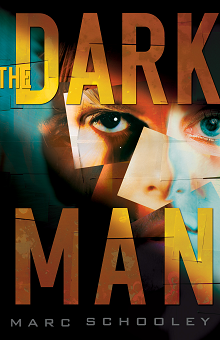 The Dark Man is now available from Marcher Lord Press. Click on the Marcher Lord Press link to the right to order. Charles Graves, Julia Jenkins, the Reverend Cleveland, Frank Cotton Graves, and (boo, hiss) Richard Fah-reese are all waiting for you. Oh yeah, the dark man is waiting for you to act as well, and he doesn’t like delays.